freyaseo1
Introduction
If you simply hear people discussing the stock market from any particular day, you’ll most likely hear a couple of names and the Nasdaq Composite Index will likely be among them. I can recall the first time I actually took the time to find out what it was, I thought it was simply “the tech index” and that’s partially correct but there’s a lot more behind the scenes. The Nasdaq Composite is composed of thousands of securities, and is known for its large price swings, is a good indicator of the sentiment of the sectors that drive innovation, and is widely considered to be a good measure of the market’s overall sentiment. While you may be a casual watcher who hears about it on the evening news or a person who’s planning on investing, it’s crucial to understand what this index represents if you want to know how to interpret the market. So let’s go through it in a way I want explained, minus the jargon wall.
The Nasdaq Composite Is Actually a Group of Stocks
The Nasdaq Composite is, in fact, a collection of stocks.
The Nasdaq is a stock market index that tracks the daily performance of nearly all of the companies trading on the Nasdaq Stock Exchange. I don’t mean just a few, in fact, it’s well over three thousand companies. That’s a much broader net than a similar one that includes only 30 large companies, such as the Dow Jones Industrial Average.
The Composite is very wide-ranging so provides you with a fairly general overview of the overall performance of the Nasdaq-listed market. It was introduced again in 1971 with a base index of 100 and has since been a handy way to track the performance of growth companies, in particular, and technology companies in general. This is typically the Nasdaq being mentioned when a reporter gives the news, “the Nasdaq closed up two percent today.
Why It Leans So Heavily Toward Technology
I was early on confused that why Nasdaq Composite was so associated with technology with all the sorts of companies being there. But this depends on how the index is weighted. It is market-cap weighted so that larger companies have a greater weight on the overall number.
The most heavily weighted names are for the biggest companies on the Nasdaq, which are often large technology companies—such as software, semiconductors, e-commerce and internet services. Although there are thousands of companies in the fray, just a few big tech companies can move the entire index up or down. The Composite is used as a gauge of the tech sector, although not all of the times.
How the Nasdaq Composite Differs From Other Indexes
Sometimes all the major indexes are grouped together; they are measuring different things. The Dow is an old-fashioned formula that tracks a small group of proven blue-chip stocks. Made up of 500 large U.S. companies in a wide range of industries, the S&P 500 is widely regarded as the best indicator of the overall health of the American economy.
The Nasdaq Composite stands out from the rest due to its wide selection and its focus on growth and innovation. It also has many smaller and younger firms that would not be included in the more prestigious indexes. The “mix” makes the Composite product more volatile. When investors are feeling optimistic about the future, it can soar. The other ones will drop when they get nervous, but it can drop harder and faster. It’s the most personal index, in my opinion, either good or bad.
What Causes the Index to Move Up and Down?
There are many factors that move the Nasdaq Composite—and once you know the more important influences, the daily news becomes more comprehensible. Interest rates are huge. If rates go up, the value of growth and tech stocks may take a hit because they rely on future earnings, so when the borrowing costs go up, so do the future earnings.
Also, the results of the largest corporations are of major importance. A big company’s report can move the index either up or down, depending on the outcome. In addition, the stock market as a whole, investor sentiment, various world events, and even a change of sentiment regarding AI or the latest trend in technology can sway the needle. The Composite is very sensitive to expectations for the future, and this is the reason for his or her extreme movement.
A History of Big Rises and Sharp Falls
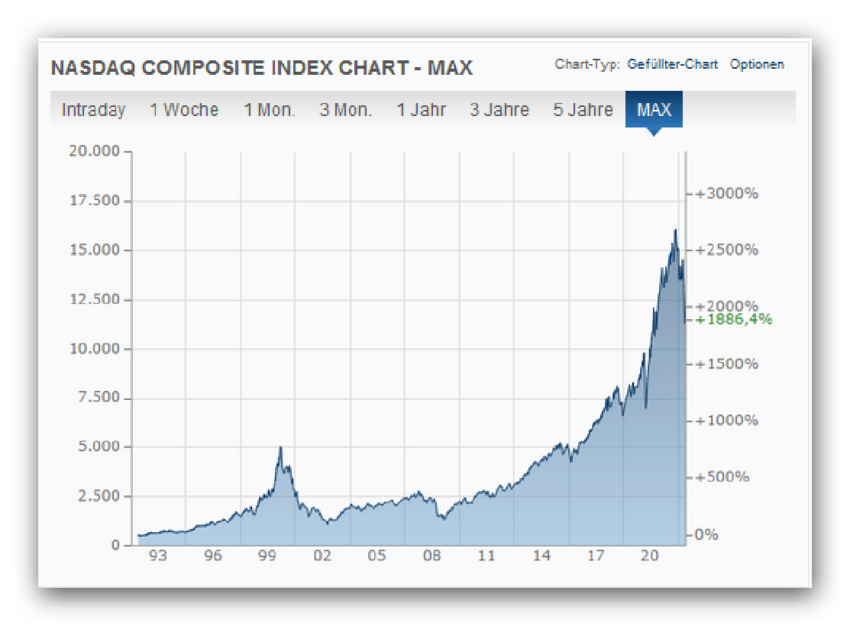
A long-term chart of the Nasdaq Composite has a lot of drama and painful crashes. The most well known is the dot-com bubble at the end of the ninetieth century and the beginning of the twenty first century. Investors loaded money into companies with internet businesses, and some of those companies didn’t have tangible profits, so the index rose sky-high. It then fell apart and lost many of its values, with years needed to recover.
It has since held its own through the 2008 financial crisis, a dramatic fall in 2020 at the onset of Covid-19 and the pullbacks associated with rate rises. However, overall, over the years, it’s been trending upward because of the rise of the technology economy. For me, it’s a reminder that the Composite is not for those lacking patience, and it does test nerves in the process.
How Regular Investors Can Get Exposed
While it is not possible to buy the index itself, you can invest in a fund that tracks the index. Regular folks can invest in the Nasdaq Composite or the related Nasdaq-100 index without having to select individual stocks via exchange-traded funds and index mutual funds.
This is how many people, including myself, like to invest in the techy side of the market. You diversify your investments among numerous companies rather than focusing on one to make a guess. It’s a more straightforward way to do it, and it removes some of the emotional stress, but it also means that you need to not mind the ups and downs of a stock like this.
Some Tips for the Road
If you’re hoping the Nasdaq Composite is a crystal ball, keep in mind that it is largely dominated by a handful of companies and stocks. If you are able to look at this index alone, you may assume that the entire market is doing well when in fact it’s just a select few giants. When considering it, it is wise to take a look at the S&P 500 or some other indicator along with it, to obtain a well-rounded perspective.
Remember that volatility is a double edged sword! The same qualities that enable the Composite to shoot up can cause it to plummet as fast. It’s not a bug, it’s a feature of an index based on growth and innovation.
Conclusion
One of those things that makes people think it’s complicated until someone explains it to them is the Nasdaq Composite. It’s a general index of thousands of companies, with a heavy weighting of the largest technology companies, and is famous for its lively, often frenetic movements. The better you grasp it, the more you’ll understand and value market news—and how to invest in innovation. It might be simply an interest in learning more or to serve as direction for your own investments, but it’s important to understand how it swings and how much it can swing. After the initial shock wears off, the Nasdaq Composite doesn’t look so scary and becomes a helpful tool.
Read More: Hb Seo Service